
The 2026 Stablecoin Regulatory Landscape
The year 2026 marks a definitive shift in digital asset oversight, characterized by the simultaneous operationalization of binding frameworks in the European Union and the United States. For global issuers, this dual-track reality eliminates the ambiguity of previous years, replacing it with distinct, enforceable compliance regimes that govern the issuance and circulation of payment stablecoins.
In the European Union, the Markets in Crypto-Assets Regulation (MiCA) has fully transitioned from legislative proposal to active enforcement. MiCA establishes a comprehensive passporting system, allowing authorized issuers to operate across all member states under a single regulatory license. The regime imposes strict reserve requirements, mandating that asset-referenced tokens and e-money tokens maintain high-quality liquid assets backed one-to-one against outstanding units. Additionally, MiCA introduces specific caps on transaction volumes to mitigate systemic risk, including a daily limit of €200 million for certain stablecoin categories to prevent excessive concentration in the payment ecosystem.
Across the Atlantic, the United States has enacted the Guiding and Establishing National Innovation for US Stablecoins (GENIUS) Act. This legislation creates a federal licensing pathway for "permitted payment stablecoin issuers," requiring them to maintain reserves consisting exclusively of US dollars, federal reserve notes, or funds held at regulated institutions. The Act explicitly prohibits digital asset service providers from offering payment stablecoins to persons in the United States unless the issuer complies with these federal standards, effectively preempting fragmented state-level laws for cross-border digital payments.
Compliance for global issuers now requires managing these parallel structures. Issuers must satisfy MiCA’s reserve segregation and disclosure mandates while simultaneously adhering to the GENIUS Act’s reserve composition and federal oversight requirements. This dual obligation necessitates robust legal infrastructure to ensure that reserve assets meet the specific definitions of both US federal law and EU regulatory standards, avoiding conflicts that could disrupt cross-border liquidity or trigger regulatory sanctions.
The convergence of these frameworks signals the end of regulatory arbitrage in the stablecoin sector. Issuers can no longer rely on jurisdictional gaps; instead, they must design their operational and reserve management systems to withstand rigorous scrutiny from both the European Central Bank’s framework and US federal agencies, including the Treasury and the Federal Reserve.
US rules under the GENIUS Act
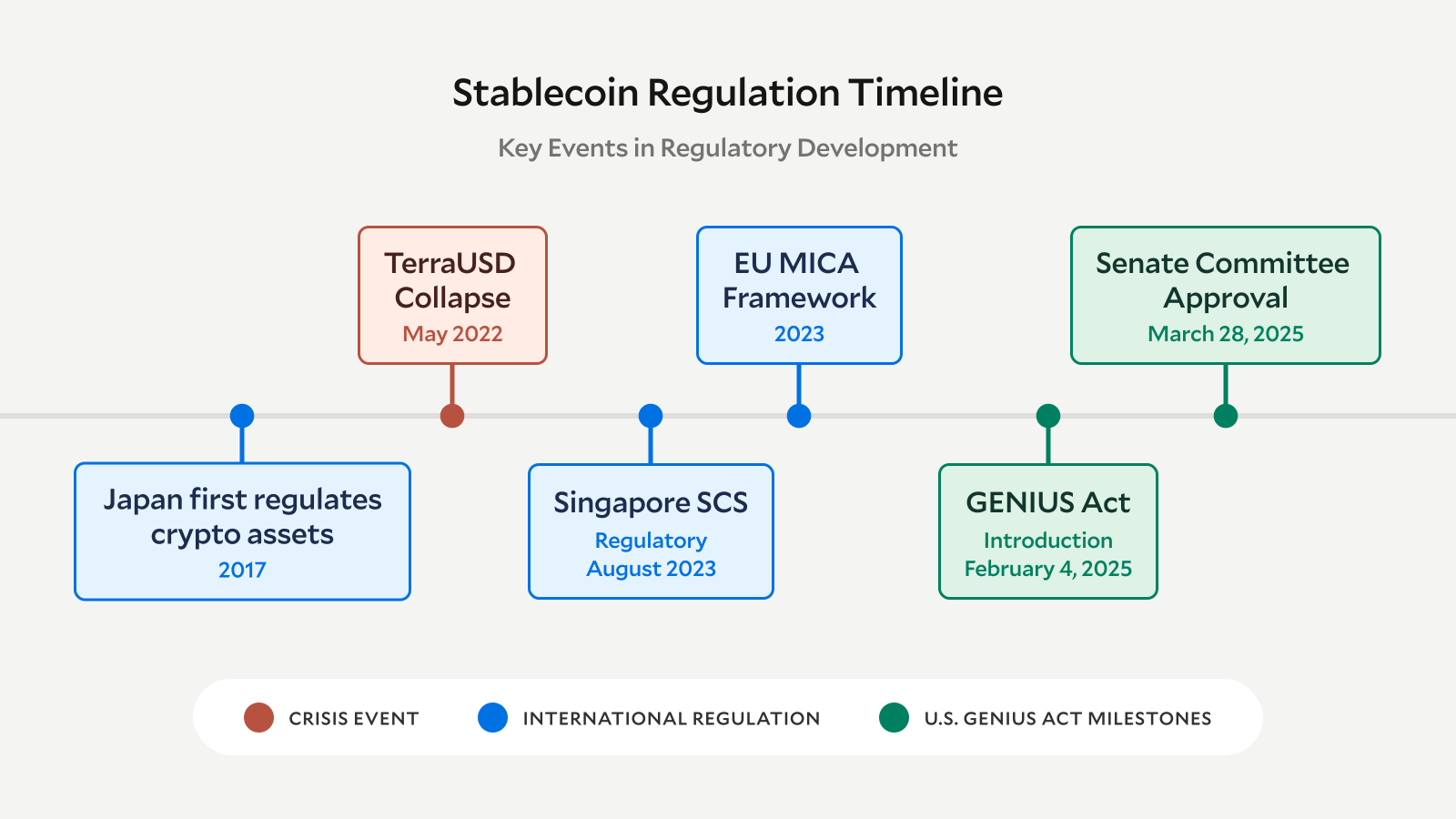
The GENIUS Act, enacted on July 18, 2025, establishes the federal regulatory framework for payment stablecoins in the United States. The legislation directs the Treasury Department and federal banking agencies to issue implementing regulations that define the operational and financial requirements for issuers. This framework aims to mitigate systemic risk by ensuring stablecoins are fully backed and managed by entities subject to strict federal oversight.
The Permitted Payment Stablecoin Issuer (PPSI) Model
Central to the GENIUS Act is the creation of the Permitted Payment Stablecoin Issuer (PPSI). This new regulatory category empowers specific financial institutions to issue stablecoins while subjecting them to comprehensive federal supervision. The Office of the Comptroller of the Currency (OCC) has proposed rules that clarify how national banks and federal savings associations can operate as PPSIs. This structure integrates stablecoin issuance directly into the existing banking charter system, ensuring that issuers adhere to capital, liquidity, and consumer protection standards mandated by federal law.
Reserve Backing and Asset Composition
The Act mandates that PPSIs maintain reserves backing their outstanding payment stablecoins on at least a one-to-one basis. These reserves are strictly limited to specified low-risk assets, including United States dollars, federal reserve notes, and funds held at insured or regulated depository institutions. The Federal Deposit Insurance Corporation (FDIC) has issued notices clarifying that deposits held as reserves backing a payment stablecoin are not insured to payment stablecoin holders under the standard deposit insurance framework. Instead, the focus is on the issuer's ability to redeem stablecoins on a one-to-one basis with the underlying reserve assets at any time.
Banking Integration and Federal Oversight
By embedding stablecoin issuance within the banking sector, the GENIUS Act leverages the existing supervisory infrastructure of federal banking agencies. The OCC and FDIC are coordinating to ensure that PPSIs maintain robust internal controls and reporting mechanisms. This integration allows regulators to monitor stablecoin activity in real-time, reducing the opacity that has historically characterized crypto-asset markets. The proposed rules emphasize that PPSIs must maintain adequate capital buffers and undergo regular examinations to ensure compliance with the Act's requirements.
Market Stability and Technical Context
The implementation of the GENIUS Act is expected to influence market dynamics for major stablecoins. Regulatory clarity may drive consolidation among issuers, favoring those that can meet the stringent PPSI requirements. Investors and market participants are closely monitoring the technical performance of regulated stablecoins to ensure they maintain their pegs during periods of market volatility. The following chart illustrates the recent trading activity of USDT, a leading stablecoin, providing context for how market stability interacts with regulatory developments.
EU MiCA Implementation and Enforcement
The Markets in Crypto-Assets (MiCA) regulation establishes the European Union’s comprehensive framework for digital assets, fully enforceable in 2026. The regime distinguishes sharply between two categories of stablecoins: Electronic Money Tokens (EMTs) and Asset-Referenced Tokens (ARTs). This classification dictates the compliance burden, reserve requirements, and operational limits imposed on issuers.
EMTs function as digital representations of fiat currency, subject to strict reserve rules requiring 1:1 backing by electronic money. In contrast, ARTs are pegged to the value of multiple assets or a single fiat currency other than the euro. MiCA imposes a hard cap on ARTs: issuers are prohibited from exceeding €200 million in daily transaction volumes. This limit is designed to prevent systemic risk from large-scale, cross-border stablecoin flows that could destabilize national monetary systems.
Reserve management is central to MiCA’s enforcement mechanism. Stablecoin issuers must maintain reserves fully backing outstanding tokens at the end of each business day. These reserves must consist of high-quality, liquid assets, ensuring immediate redeemability. The regulation mandates transparent reporting and regular audits to verify compliance, providing regulators with the data necessary to monitor market integrity and protect consumers.
| Feature | EMT | ART |
|---|---|---|
| Primary Peg | Single Fiat Currency | Multiple Assets or Fiat |
| Daily Volume Cap | No Specific Cap | €200 Million |
| Reserve Requirement | 1:1 Fiat Backing | 1:1 Asset Backing |
Reserve Asset Standards and Transparency
The regulatory architecture for stablecoins in 2026 is defined by strict reserve requirements and mandatory transparency. Both the European Union’s Markets in Crypto-Assets (MiCA) regulation and the United States’ GENIUS Act mandate that issuers maintain reserves fully backing outstanding tokens on a one-to-one basis. However, the specific composition of these reserves and the frequency of verification differ significantly between the two jurisdictions.
Under the GENIUS Act, issuers must hold reserves consisting primarily of high-quality liquid assets (HQLA). These include US dollars, Federal Reserve notes, and funds held at regulated institutions. The legislation requires daily attestation of these reserves, ensuring that the backing assets are immediately available to meet redemption requests. This approach prioritizes liquidity and safety, limiting exposure to volatile or illiquid instruments.
MiCA adopts a similar but more granular framework. It categorizes reserve assets into two types: Asset-Referenced Tokens (ARTs) and Electronic Money Tokens (EMTs). ARTs must hold a diversified basket of assets, while EMTs are backed 1:1 by fiat currency. Both require regular audits and public disclosure of reserve compositions. The EU framework emphasizes diversification and risk mitigation, whereas the US model focuses on strict liquidity and regulatory oversight.
The following table compares the core reserve requirements of the GENIUS Act and MiCA.
| Feature | US GENIUS Act | EU MiCA |
|---|---|---|
| Backing Ratio | 1:1 | 1:1 |
| Reserve Composition | HQLA, USD, Fed Reserve notes | Diversified basket (ART) or Fiat (EMT) |
| Verification Frequency | Daily attestation | Regular audits and public disclosure |
| Asset Eligibility | Limited to specified liquid assets | Broad but risk-weighted categories |
Market Impact and Adoption Trends
The regulatory clarity provided by MiCA and the proposed GENIUS Act is accelerating institutional adoption of stablecoins. Unlike speculative assets, stablecoins are increasingly viewed as infrastructure for cross-border payments and treasury management. This shift is driven by the need for compliance with anti-money laundering (AML) standards and reserve transparency requirements.
A 2026 report by Rapyd highlights this trend, noting that 64% of businesses surveyed already use stablecoins or plan to within three years. The primary drivers are speed, reduced transaction costs, and easier cross-border settlements. This adoption is not merely experimental; it represents a structural move toward compliant digital assets that meet traditional financial regulatory standards.
The GENIUS Act further solidifies this environment by requiring permitted payment stablecoin issuers to maintain reserves backing outstanding stablecoins on at least a one-to-one basis. Reserves must consist of specified assets, including US dollars, Federal Reserve notes, or funds held at regulated institutions. This requirement reduces counterparty risk and aligns stablecoin operations with traditional banking reserve practices.
As regulations mature, the market is consolidating around issuers who can demonstrate strict compliance. This trend favors established players who can manage the complex legal landscape of MiCA in the EU and emerging US federal guidelines. The result is a more stable, institutional-grade market for digital dollar equivalents.
No comments yet. Be the first to share your thoughts!