
What stablecoin laws 2026 mean for issuers
The regulatory landscape for digital assets shifted from debate to enforcement in 2026. The GENIUS Act, enacted on July 18, 2025, is now the primary framework governing payment stablecoins in the United States. Issuers are no longer operating in a gray area; they are subject to binding federal regulations that prioritize reserve backing and consumer protection.
The transition from proposed rules to active licensing is underway. The Office of the Comptroller of the Currency (OCC) and the Federal Reserve have released notices of proposed rulemaking to implement the GENIUS Act. These documents, published in the Federal Register in early 2026, outline the specific reserve requirements and operational standards issuers must meet to operate legally.
Globally, the European Union’s Markets in Crypto-Assets (MiCA) regulation is already in force, creating a parallel compliance path for international issuers. This harmonization effort means that stablecoin operators must navigate a more unified, yet complex, set of rules across major jurisdictions. The focus for 2026 is on strict adherence to these new standards, with licensing decisions and enforcement actions becoming the norm rather than the exception.
Issuers must prioritize compliance with reserve requirements and maintain transparent reporting structures. The era of self-regulation has ended, replaced by a structured framework designed to integrate stablecoins into the broader financial system safely.
How the GENIUS Act reshapes US compliance
Enacted on July 18, 2025, the GENIUS Act establishes a federal regulatory framework for payment stablecoins. The legislation shifts oversight to federal banking regulators, requiring issuers to register and adhere to strict reserve requirements. This marks a significant departure from the fragmented state-by-state approach that previously governed the industry.
The 1:1 Reserve Mandate
The core requirement of the GENIUS Act is the 1:1 reserve mandate. Issuers must hold at least $1 of permitted reserves for every $1 of stablecoins issued. This ensures that every token in circulation is fully backed by high-quality liquid assets, protecting consumers from insolvency risks. The rule aims to eliminate the fractional reserve practices seen in earlier stablecoin models.
Permitted Reserve Assets
The Act limits permitted reserves to specific, low-risk assets. Issuers can only hold cash, short-term U.S. Treasury securities, and other assets deemed safe by regulators. This restriction prevents issuers from investing stablecoin reserves in corporate debt or volatile crypto assets. The goal is to maintain liquidity and stability, ensuring issuers can meet redemption demands instantly.
Federal Oversight and Rulemaking
Federal banking regulators, including the OCC and the Federal Reserve, are tasked with enforcing these rules. In March 2026, the OCC released a Notice of Proposed Rulemaking to detail the operational requirements for compliance. Issuers must now navigate a structured approval process, including regular audits and public disclosures. This framework provides clarity but also introduces significant operational burdens for new and existing stablecoin providers.

Global stablecoin regulation and US alignment
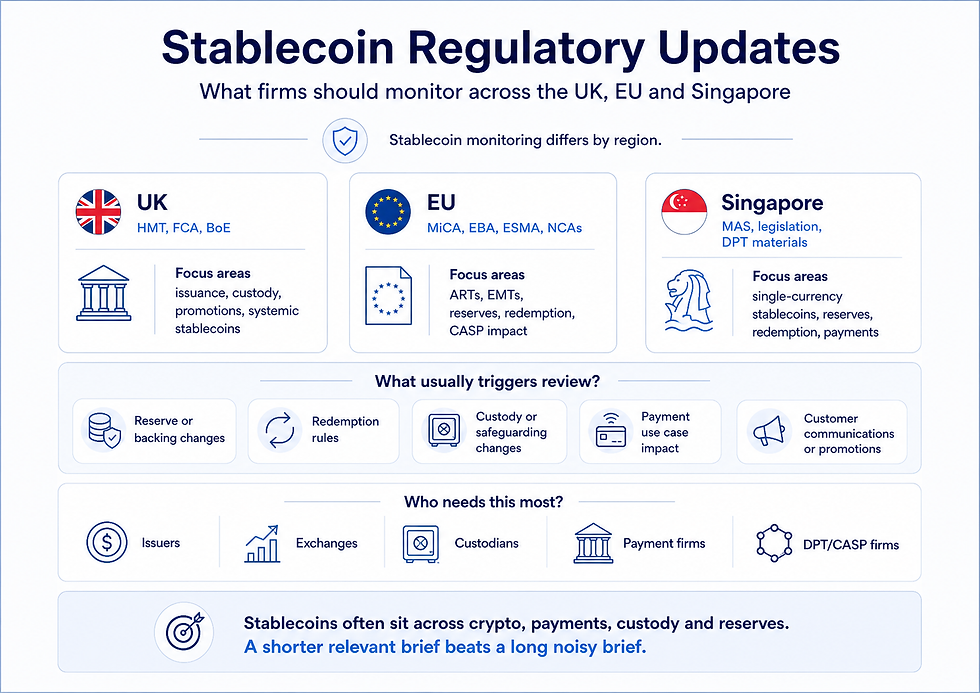
The GENIUS Act establishes a federal baseline for payment stablecoins in the United States, but it operates within a fragmented global landscape. While the US focuses on federal preemption for payment tokens, the European Union and the United Kingdom are pursuing different regulatory architectures. The trend across these major jurisdictions is not uniformity, but rather a move toward functional harmonization—where distinct rules achieve similar outcomes for reserve backing and consumer protection.
The European Union’s Markets in Crypto-Assets (MiCA) regulation, fully applicable since 2024, imposes strict requirements on Asset-Referenced Tokens (ARTs) and E-Money Tokens (EMTs). MiCA mandates full reserve backing, regular auditing, and significant disclosure obligations. Unlike the US approach, which often relies on existing banking frameworks or new federal charters, MiCA creates a unified passporting system across all 27 member states, allowing issuers to operate across borders with a single license.
The United Kingdom is currently drafting its framework to bring fiat-backed stablecoins into the existing financial perimeter. Rather than creating a new crypto-specific regime, the UK plans to amend existing financial legislation, treating stablecoin issuers similarly to traditional payment providers. This approach aims to leverage established regulatory expertise while addressing the specific risks of crypto-asset volatility. Draft rules are expected to finalize in 2026, with enforcement following shortly after.
These divergent paths reflect different legal traditions but converge on core stability principles. All three jurisdictions now require high-quality liquid assets to back stablecoin liabilities, prohibiting fractional reserve systems. The primary difference lies in licensing and cross-border recognition. The US GENIUS Act focuses on federal oversight of payment stablecoins, while MiCA and UK rules cover a broader range of crypto-assets with varying levels of integration into traditional finance.
| Jurisdiction | Primary Framework | Reserve Requirement | Scope |
|---|---|---|---|
| United States | GENIUS Act (Federal) | 1:1 High-Quality Liquid Assets | Payment stablecoins only |
| European Union | MiCA (Regulation) | Full Backing + Auditing | ARTs and EMTs |
| United Kingdom | Draft Financial Services Bill | Equivalent to Payment Institutions | Fiat-backed stablecoins |
The lack of a single global standard creates compliance complexity for issuers operating across borders. A stablecoin compliant in the EU may not automatically qualify under US federal rules, and vice versa. This fragmentation forces issuers to maintain separate legal structures and reserve accounts for different jurisdictions. However, the convergence on reserve quality and disclosure standards suggests that international cooperation may eventually lead to mutual recognition agreements, simplifying cross-border operations.
Reserve requirements and banking partnerships
The GENIUS Act mandates a strict one-to-one backing ratio, requiring issuers to hold at least $1 of permitted reserves for every $1 of stablecoins issued. This requirement shifts the operational burden from mere accounting transparency to physical custody of high-quality liquid assets. Issuers must now navigate a complex landscape of reserve eligibility, ensuring that the assets backing their liabilities meet federal standards for safety and liquidity.
A critical operational hurdle is the exclusion of deposit insurance for these reserves. Under the FDIC’s proposed rulemaking to implement the GENIUS Act, deposits held as reserves backing a payment stablecoin are not insured for payment stablecoin holders. While the issuing bank may hold these funds, the stablecoin holders themselves have no claim to FDIC protection on those specific balances. This distinction separates stablecoin reserves from traditional consumer savings accounts, placing the onus of solvency directly on the issuer’s reserve management rather than on federal safety nets.
Because of this lack of insurance and the strict reserve requirements, establishing partnerships with traditional banking partners has become non-negotiable. Issuers cannot simply hold reserves in unregulated custodial wallets; they must secure accounts at institutions that can manage the requisite fiat and short-term Treasury holdings. These banking relationships are no longer just for processing payments but serve as the primary vault for the stablecoin’s backing assets. Without a trusted banking partner capable of segregating and reporting these reserves, an issuer cannot comply with the new federal standards.
Compliance checklist for stablecoin issuers
The GENIUS Act, enacted July 18, 2025, establishes the regulatory framework for payment stablecoins [1]. Issuers must align with the Office of the Comptroller of the Currency (OCC) guidelines to operate legally. The Federal Register published proposed rules on March 2, 2026, detailing the specific requirements for permitted payment stablecoins [2]. The following steps outline the compliance path.
Issuers must hold reserves in cash and short-term U.S. Treasury obligations. The OCC requires these assets to be fully backed and readily redeemable at par. Regular audits verify that the reserve ratio remains at 100% to protect holders against volatility.
A dedicated custodial account at a regulated U.S. financial institution is mandatory. This ensures that reserve funds are segregated from operational capital. Issuers must provide proof of this arrangement to the OCC before launching any payment stablecoin product.
Issuers must submit a formal application to the OCC. The proposal includes business plans, risk management protocols, and technology infrastructure details. Approval is contingent on demonstrating that the stablecoin will not pose systemic risks to the U.S. financial system.
No comments yet. Be the first to share your thoughts!