


When President Donald Trump signed the GENIUS Act into law on July 18,2025, the world of stablecoin regulation in the United States changed overnight. Suddenly, what had been a patchwork of state-level rules and ambiguous federal guidance was replaced with a sweeping national framework that set a high bar for transparency, consumer protection, and financial stability. For legal professionals, crypto industry participants, and regulators alike, understanding these changes is not just helpful, it’s essential.

The Heart of the GENIUS Act: Full Reserve Backing
The most headline-grabbing feature of the GENIUS Act is its full reserve requirement. Every payment stablecoin issued under this law must be backed one-to-one by highly liquid assets, think U. S. dollars and short-term Treasury securities. No more fractional reserves or risky commercial paper lurking in the background. This means every digital dollar circulating as a stablecoin can be redeemed for an actual dollar at any time.
This approach addresses years of skepticism from both regulators and consumers about whether stablecoins were truly as “stable” as promised. By mandating 100% backing in safe assets, the GENIUS Act aims to eliminate the risk of runs and bolster trust in U. S. -pegged digital assets. For those needing a deep dive into how these reserve requirements function in practice, and what it means for compliance teams, check out our detailed guide: GENIUS Act Explained: U. S. Stablecoin Regulations, Reserve Requirements, and Compliance in 2025.
Enforced Transparency: Audits and Public Disclosures
Transparency isn’t just encouraged under the GENIUS Act, it’s required by law. Stablecoin issuers must publish monthly reports detailing their reserve holdings and asset composition. For issuers with more than $50 billion in market cap (and yes, that’s most major players), annual independent audits are mandatory.
This dual-layered approach ensures not only regular public scrutiny but also professional third-party oversight to catch discrepancies early. The hope is that these requirements will prevent another Terra-style collapse or hidden insolvency from blindsiding users or markets. In practical terms, this means compliance officers will need robust systems for tracking reserves in real time, as well as relationships with reputable auditors who understand both crypto assets and traditional financial controls.
Licensing: Only Federally Approved Institutions Need Apply
The days when anyone could launch a U. S. -dollar stablecoin with little more than an LLC are over. Under the GENIUS Act, only federally supervised entities, like FDIC-insured banks or OCC-licensed nonbanks, can issue payment stablecoins legally within the United States.
This move centralizes oversight at the federal level while preempting conflicting state laws that previously created headaches for multi-state operations. It also signals to global partners that American stablecoins are subject to rigorous standards on par with traditional financial institutions, a critical factor as cross-border use cases expand.
- Key takeaway: If you’re not already federally licensed or planning to become so, issuing a compliant U. S. -dollar stablecoin is now off-limits.
- Systemic risk reduction: Centralized licensing aims to prevent regulatory arbitrage and ensure all major issuers meet consistent safety standards.
If you want to see how this plays out for existing projects, and what steps new entrants must take, our breakdown here covers it all: GENIUS Act Explained: US Stablecoin Licensing, Reserve and Audit Rules (2025).
The Global Ripple Effect: Dollarization and Digital Sovereignty Concerns
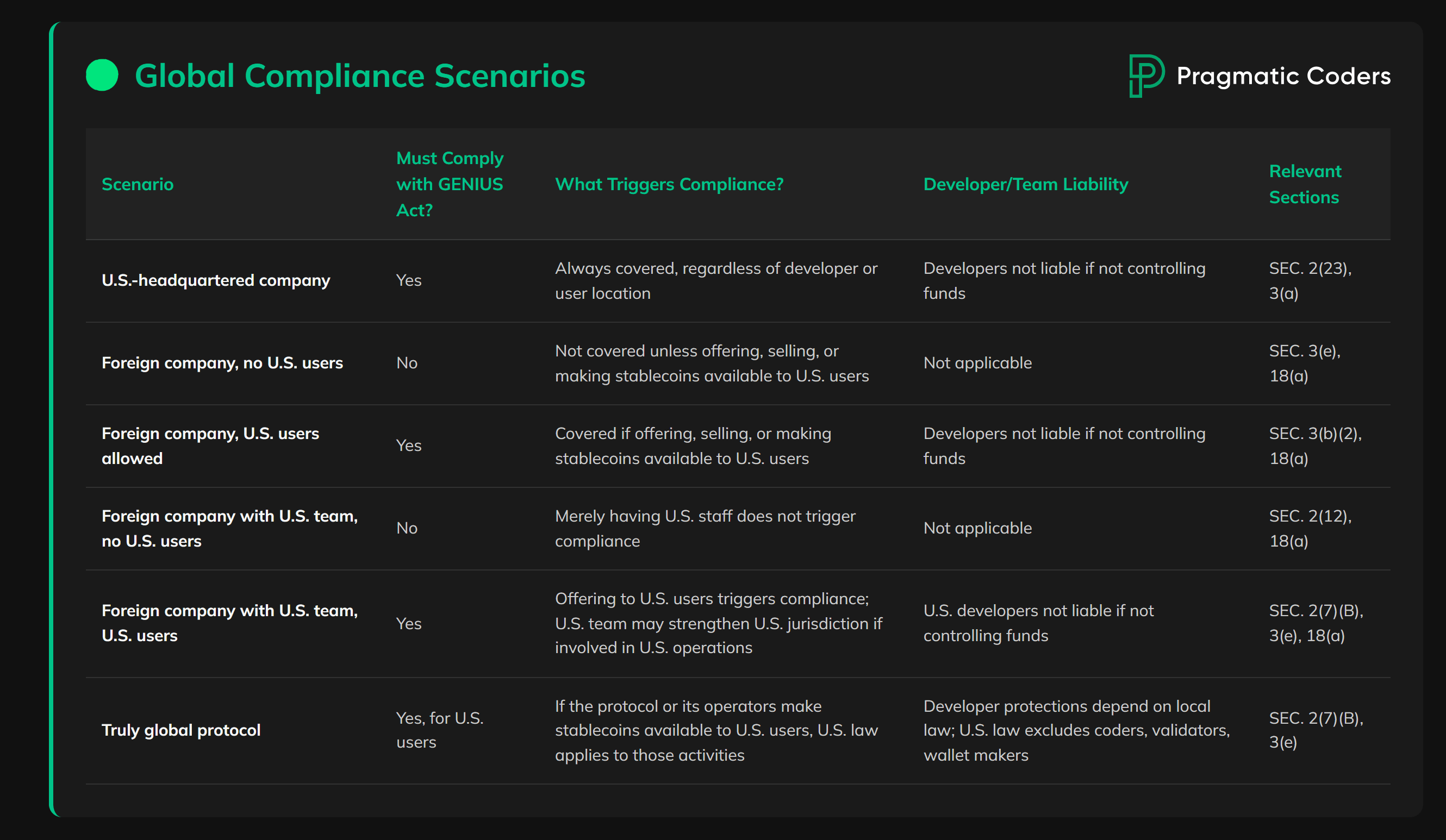
The GENIUS Act’s impact doesn’t stop at America’s borders. By setting such high standards for reserve backing and transparency, and by leveraging the global reach of the U. S. dollar, the law has triggered international debate about monetary sovereignty and global payments stability.
European regulators, led by asset management giant Amundi, have warned that widespread adoption of U. S. -dollar-pegged stablecoins could undermine national currencies and destabilize local payment systems. Meanwhile, Chinese officials have openly called for accelerated development of yuan-backed digital currencies as a counterweight to potential “digital dollarization. ” These moves highlight how regulatory decisions made in Washington can reshape strategies from Brussels to Beijing.
This is just one facet of how U. S. policy now influences global digital finance, a dynamic we’ll explore further in part two of this article series.
For stablecoin issuers and compliance teams, the GENIUS Act’s global impact means that U. S. -based projects will be held up as models, or cautionary tales, in regulatory circles worldwide. International firms seeking to do business in the U. S. market must now align with America’s full-reserve, audit-heavy framework or risk exclusion. Conversely, some jurisdictions are racing to establish their own digital currency initiatives, hoping to retain monetary control and avoid dependence on a dollar-centric system.
Yet, this new landscape isn’t just about geopolitics or macroeconomics. On the ground, stablecoin users are already seeing tangible changes. Monthly transparency reports and annual audits are making it easier for everyday users and institutional clients to verify that their digital dollars are truly safe. This could help restore trust after several high-profile failures in recent years.
Compliance Realities: AML, Marketing Rules, and Ongoing Supervision
The GENIUS Act also brings a sharp focus on anti-money-laundering (AML) compliance and consumer protection. Issuers must implement robust KYC/AML programs equivalent to those used by traditional banks, no more gray areas or offshore shortcuts. Additionally, strict marketing rules prohibit misleading claims about stability or returns, with federal regulators empowered to levy fines or revoke licenses for noncompliance.
This shift means compliance is no longer a box-ticking exercise; it’s an ongoing operational commitment. For many fintech startups and DeFi projects, this will require significant investment in legal counsel, technology upgrades, and internal controls. But for those who get it right, the payoff is access to a much larger, and more secure, market.
What Comes Next? Industry Adaptation and Regulatory Evolution
As with any sweeping law, implementation is where theory meets reality. The Stablecoin Regulatory Compliance Council (SCRC): the new oversight body created by the Act, has already begun issuing guidance on technical standards for reserve reporting and audit best practices. Industry groups are lobbying for clarity around cross-border payments and interoperability standards.
Some early movers have already secured federal licenses under the new regime; others are restructuring operations or seeking partnerships with existing banks to stay compliant. Meanwhile, smaller issuers may exit the U. S. market entirely due to the cost of compliance, a trend that could reshape the competitive landscape over the next year.
If you’re navigating this transition, whether as an issuer, legal advisor, or investor, staying informed is crucial. Our resource hub breaks down every major rule change and offers practical checklists for compliance readiness: GENIUS Act 2025: How the New US Stablecoin Law Impacts Issuers, Banks and DeFi.
Key Takeaways for Legal Teams and Market Participants
- Full reserve backing is now non-negotiable for all U. S. -issued payment stablecoins.
- Monthly public disclosures and annual independent audits are mandatory for large issuers.
- Only federally licensed institutions can legally issue payment stablecoins in the U. S.: state charters alone no longer suffice.
- KYC/AML programs, stringent marketing rules, and ongoing federal oversight have raised the bar for compliance across the board.
- The global influence of U. S. policy is spurring both collaboration (via interoperability) and competition (via rival CBDCs) abroad.
The GENIUS Act has set a new benchmark not just for American crypto regulation but for digital asset frameworks worldwide. Whether you see this as an overdue modernization or regulatory overreach depends on your vantage point, but one thing is clear: stablecoins will never operate in regulatory limbo again.
About the Author